Post-Modernism's 'Observer Effect' Problem
"I don't think that term means what they think it means," says Inigo. He's right.

In my previous discussion on postmodernism, I made an unforgivable mistake: I failed to discuss the comprehensive misapplication of a critical scientific reality known as the “observer effect.” This failure to mention the willful misuse and abuse of this concept by humanities professors is risible. Herein lies my humble attempt to remedy said error.
First, I must needs explain what the observer effect is and how it applies to quantum mechanics, you know, the science of subatomic physics. I’m going to oversimplify and promise to eschew math. So, don’t judge me and don’t you dare corect me in my haste to make this easy for you.
Oversimplifying is an art, watch Rembrandt at work!
Truth is math would make it easier for me to explain, but seriously, do you really want me to explain this:
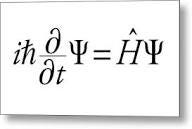
I didn’t think so.
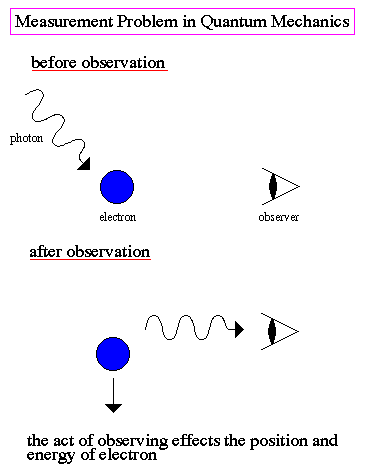
The quantum observer effect is the principle that the act of measuring a quantum system alters its state. Before a subatomic particle is measured it exists in a state known as superposition, imagine a kinda-sorta wave. It’s essentially in two places at once. Or, like the cat, both dead and alive. Weird, right? It gets weirder.
Measuring for the subatomic particle is what nerdy sciencey-types call ‘collapsing the wave function.’ When you do that the phenomena you are measuring acts like a particle, no longer like a wave. When measuring (read: observing) a subatomic particle, say an electron, you can measure the direction (vector to be precise) it is traveling or you can measure where it is, but you cannot measure and therefore know both. It cannot be done. Bizarre, I know. But true.
To repeat: before you measure, the particle is in what’s called superposition but once you make an observation the wave function (superposition) collapses and what you were measuring as a wave now behaves like a particle. This allows you to measure the direction of the particle or the location of the particle, but you can’t know both at the same time.
Why that is, I don’t fucking know?
Even Cousin Albert the Einstein was flummoxed by this spooky action at a distance, as he called it. No, wait, that’s quantum entanglement. I’m not going there. If I did I’d be locked into a week long navel gazing session I can ill afford.
To summarize: when you, or the mechanical apparatus you use, observes the subatomic particle its fundamental nature is altered.
Feel me?
Not to get too deep in the weeds here, but some have argued that consciousness is required to initiate the observer effect. It does not matter whether the observer is a mechanical apparatus or a conscious mind. The effect is the same. Science has refuted the idea that a conscious mind is necessary to the process. Remember this: it is important later.
So, how humanities instructors expropriated this term and abused it like Chris Brown smacked Rihanna is a tale of continental scale intellectual lassitude symptomatic of nothing less than the collapse of Western Civilization.
Hyperbole much?
I know two history professors who truly understand the observer effect and both teach a history of science senior seminar, a truly worthwhile if thankless endeavor. So here’s how the humanities hijacked this scientific reality and used it to justify all kinds of moral and ethical depravity in the pursuit of academic freedom.
The post-moderns transmogrified the scientifically demonstrable observer effect into a sociolinguistic and epistemic tool used, pettifogging-like to prove there is no objective, independently verifiable reality. Because, sayeth the wise po-mo sages, reality is observed, thus it’s a negotiated construct, modified by the observer at will.
Tautology is what it is!

This reinterpretation (I’m being generous) allows for all kinds of intellectual shenanigans.
To wit: it prioritizes creation over observation.
What the fuck does that even mean?
Apparently the observer just conjures shit up out of thin air like a medieval necromancer. Is it scientifically demonstrable and replicable in a lab?
Well, last week I visited my local post-modernist shaman and tried to conjure up Sydney Sweeney.
So, no.

Even more egregious is how the post-modern observer effect commandeered the idea that narratives are like quantum particles: they exist in superposition until they are interpreted by a ‘subjective agent.’ Attend: any time an academic or politician or newscaster uses the word ‘narrative’ your bullshit detector ought scream at earsplitting decibels.
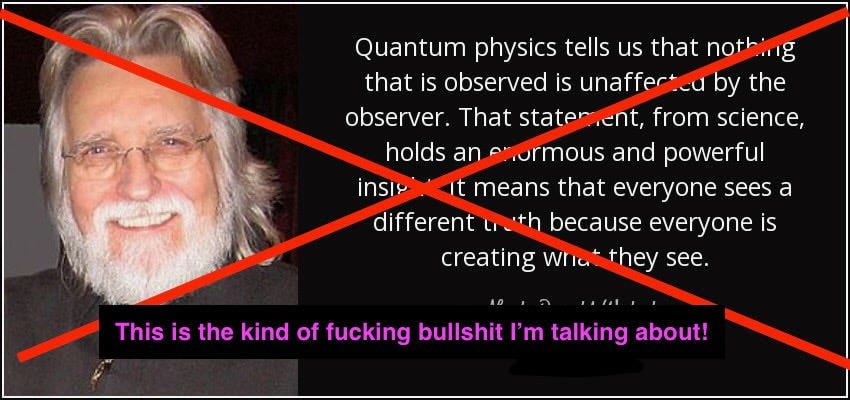
All this is to say that post-modern thought denatures scientific reality into textual rhabdomancy thereby placing the observer “in a position of “personal power,” where changing one’s interpretation can change their experienced world,” says Larry Gottlieb.
I wonder if changing my interpretation of my bank balance changes my experience at the ATM?
Yeah, probably not.
The key takeaway here is that the post-modern ‘observer effect’ bears absolutely no resemblance to the scientific reality its practitioners attempt to conflate it with. Science can be proven (or falsified) in the lab, in real time. The humanities interpretation cannot be proven, only circle-jerked to death whilst reading Derrida during a séance summoning dear old dead Aunt Joan. It’s not science, its charlatanism.
Observo, ergo sum.
“Well,” says Descartes, “fuck off.”

But the worst aspect here is how the hijacking of the observer effect lead po-mo down some of the most perverse and subversive rabbit holes imaginable. What was almost respectable philosophical thought is now fabricated witchcraft, as if Foucault and Derrida bumped uglies and birthed Camile Paglia.
Codswallop!
Clamjamphrie!
Tommyrot!
Bilge baloney!
It’s a concept dreamed up by an eight year old suffering a fever dream that’s been used to justify all kinds of academic, moral and ethical bovis stercus; intellectual laziness disguised as standing on principle; poseurs running amok amidst the once hallowed halls of academia.
It’s time for some whiskey.
*More for you Nick Borodinov and you too Ann K Sterzinger.
I must protest. Ms. Paglia actually admitted biology was real in Sexual Personae, which got her a whole bunch of enemies.
That said, there is one bit of the equation that is, I think, comprehensible by the layman.
The uncertainty determined by Planck’s constant is based on h-hat, which is… 1.054571817...×10−34 J⋅s. That’s right, you can’t know momentum and position to a product of less than, 1.054571817...×10−34 J⋅s.
Which is roughly .01 but with 33 zeroes in front of the 1.
So yeah, you can know things to a pretty reasonable approximation for any real-world level you would care about.
Oh wow! Someone actually DID understand my essay about the English “professor”!